
Autumn and winter 1054, in which two beasts from the beginning of time challenge Alegate.
Fire Below
The Gorlak Adventurer
In the deepest cavern, the gorlak adventurer knew he was in trouble. He waded along the shore of the silent lake, hiding from the creeping eyes. Two of them saw him and came after him. He kicked one in the eye (there was little other place to kick it) but the other raked him with its claws.
“Help! Save me!” The gorlak cried. His voice echoed off the surrounding rock, but he knew there was no one to hear. He had not yet found the dwarves rumored to be here. He shoved the remaining monster and backed toward the mossy shore. He hoped to evade the beast in the stalagmites.
As he felt dry floor fungus begin to crunch under his feet, a bright blue light illuminated the scene. The evil eye’s pupil contracted to a pinpoint and focussed on something behind the gorlak. The water on the gorlak’s skin evaporated in an instant as a glob of white flame shot from behind him, passed over his head, and struck the creeping eye.
The effect was remarkable. The monster began to melt a moment before the glob struck. When the glob did strike, the creeping eye was not thrown back, but rather ruptured. Ichor shot out as pressurized steam for a moment before the creature collapsed.
The gorlak, his eyes stinging from the glare, turned toward the source of the blue light. At first he only saw roiling smoke between the gold-speckled stalagmites. Then an immense blob of blue fire rolled slowly out of the clouds. The cave moss erupted into red flame all around it. The blob stopped and twisted, as if to regard him. Then it extruded two scorpion-like tails of fire, complete with stings. The radiant heat hit the gorlak’s skin like a wave breaking over him.
The last thing the adventurer saw was a great fan of flame washing out from the fiery forgotten beast. The last thing he heard was the formerly silent lake roaring as it boiled.

Peephole
Argus stepped back from the peephole and looked around the candle-lit barracks. It was packed with the wood cutters, haulers, and soldiers. They had fled here when the fiery forgotten beast was first detected. The diorite door to the cavern was sealed. Now that the cavern-fire had burned all but the most resilient of the giant mushrooms, there was nothing to see but ash and reflected firelight. The chamber smelled of smoke and sweaty dwarves.
“It’s still out there,” Argus reported. “But I don’t see it.” He sat on an indigo nether-cap log. The log was icy cold.
“How do you beat something like that?” a soldier asked. “It’s too close out there for crossbows, and anything near it catches fire. It’s hard to even tell where it is, with all that choking smoke.”
“Go get that visiting scholar,” Argus grunted. He snapped a twig off the icy log and dropped it in his mug.
Ral the Astronomer
“This is the opposite of Astronomy,” Ral complained.
Argus did not accept that answer, “you’re a scholar. So scholar for us. How do we beat it?”
Ral sighed. “It is known as Figul Oozelice the Mite of Drool. It was seen in our mountainhome when the first mines were being dug. It killed a child before they could seal that mine. That’s all I know. Oh, except for one other thing. It’s a forgotten beast, and no one has killed a forgotten beast before. Maybe they can’t die.”
Argus sipped from his cool brew, thoughtfully.

The fiery blob, roaming the caverns. In an example of Dwarf Fortress physics, the blob’s body heat raises the ambient temperature nearby, the cave plants catch fire, the fire spreads, and smoke billows into the air. A little while later, this area was nothing but ash and stone.
The Divinely Inspired Mayor
Mayor Thornbeard, once scout and huntsman, had not left the mayoral chambers in a while. He had thrown himself into the unfamiliar world of fortress administration. His days were full of the scent of chalk, the clatter of abacuses, and the scratching of turkey feather pens.
Mayors are not required to do this. They are elected to speak for the fortress on business matters. They formalized agreements with the mountainhome, travelling entertainers, and mercenaries. They are also expected to be available for citizen complaints.
Thornbeard, inspired by Zeffon Yearlingfountains The Blossom Budding, was making sure Alegate was all it could be. The fort had a book keeper (known as “Books”) to count the stocks and take care of work assignment details, but a great deal of administrative work was needed to make this fort all it could be.
One of the things Thornbeard had done was update all mercenary contracts. The majority of the military — about a quarter of the Alegate’s population — were mercenaries. The only citizen-soldiers were the squad leaders and a few who had been with the militia since the early days. The mercenaries were loyal soldiers, worked for room and board, and freed up citizens for other work, so this was good.
There was more he wanted to do. He had meant to spend more time in nature, and learn to craft instruments, and other things. He did not know when he would get to that.
The Barbican
Mayor Thornbeard made sure the new defensive structure got built. It had high, yellow walls that enclosed a courtyard and extended to protect the west draw bridge. The south side had a gate protected by fortified archer towers.
The sunny courtyard was big enough for the fort’s archers to train. Above the training yard was mounted the inspiring alpaca shield. The courtyard also had space for the dozens of puppies to roll and play, and eventually be trained as war-dogs.
This barbican not only protected the approach to the main courtyard, but provided a much safer way for the scouts to keep watch on the southwest.

The narrow south-facing entrance was protected by a “goblinite” portcullis that Argus had ordered. Many of last spring’s attackers had brought low-quality copper armor and weapons. Alegate’s military claimed some of these items, but the rest was being melted down so it could be worked into something finer. Argus called the resulting metal goblinite, and the name was becoming popular in the fort.
New cage traps were being set south of the goblinite gate. Cage-huts were constructed south of the traps, and four of the captured attackers would be living in these. The prisoners would be the first to greet the next army from the Flighty Hex. The fifth prisoner would remain caged in the Baron’s audience chamber, as a conversation piece. These cages were more of Argus’ flourishes.
The architect expected to be done by spring, as long as the haulers kept placing blocks, the masons keep cutting new blocks, the miners kept supplying stone, the cooks kept everyone fed, and so on. In short, it takes a lot of organization to build a castle.
Secret Tunnels
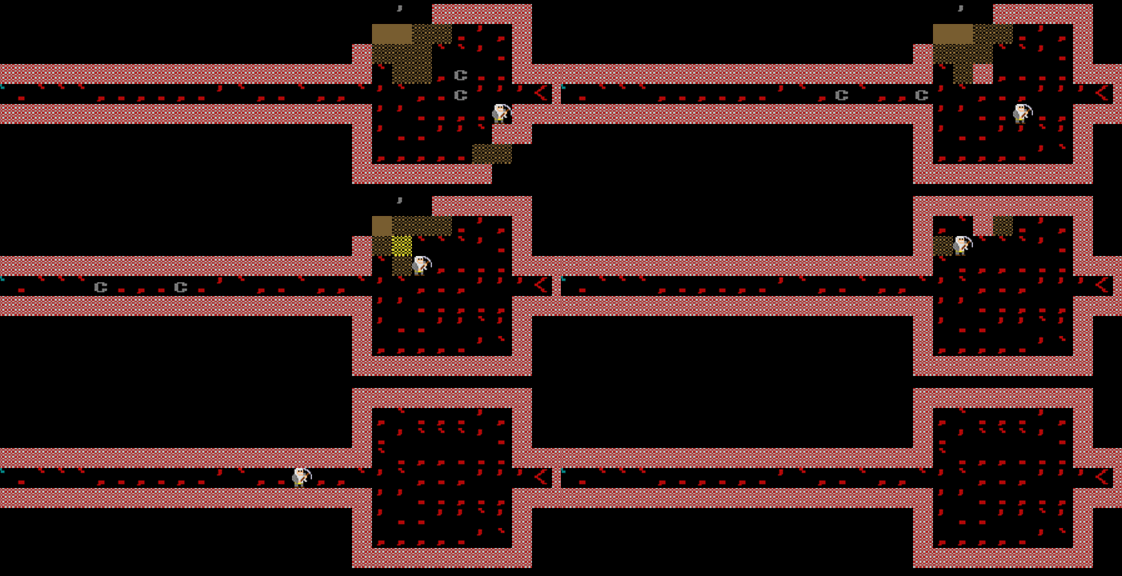
Mayor Thornbeard had mandated secret tunnels. They would be complete by spring. They led out from the clay delvings to points southwest, west, and northwest of the fort. Each tunnel led to a chamber where troops could gather, with a stairwell to the surface. The next time a force laid siege to Alegate, any citizens caught on the surface could disappear into these tunnels. Alegate’s troops could use the tunnels to make surprise attacks behind enemy lines. Lockable hatches covered the tops of the stairwells, and sturdy stone doors could block the tunnels in case something slipped past the hatches.

The Queen’s Representative Arrives
Mayor Thornbeard’s work was frequently interrupted by visitors, work applicants, and other meetings. When Queen’s Representative Bathru arrived from the mountainhome with the autumn caravan, Thornbeard was again interrupted.
Thornbeard offered to show the official to the Baron, but Bathru declined. Barons are nobles, Bathru explained, while Bathru was only a commoner representing the business interests of the Queen. But Bathru did have some news on that matter: Alegate was being elevated from Barony to Duchy, skipping right over the middle “County” rank. Alegate was expected to decorate Maltose’s chambers to Ducal quality, so that he could appropriately impress foreign dignitaries.
Thornbeard then discussed trade agreements with Bathru for next year. Thornbeard asked that next autumn’s caravan bring extra musical instruments, cloth and cheese.
Finally, at Duke Maltose’s suggestion, Thornbeard informed Bathru that Alegate would send a gift of brew and finely carved bone and shell to the Queen. Argus, as Alegate’s broker, would work out the details with the caravaneers.
Stathra the Poet
For two years, Stathra had worked in The Drowned Langur as an entertainer. She was a friendly dwarf, though a little odd from her upbringing in the Vigorous Confederacy. Thornbeard was particularly fond of this amethyst-eyed performer.
She showed up in Thornbeard’s mayoral chambers to petition her entertainment contract be terminated and she become a full citizen. Thornbeard did not hesitate to grant her petition.
From previous conversations, he knew Stathra had published a number of poems, and even used to train aspiring poets in Evildwells. He hoped to find out more about her, but did not know when he would have the time.
Talons Above
There was only one Roc in the world. It was like a white-feathered osprey, but the size of four elephants. That made it twice the size of the forgotten beasts in the caverns. More has been written on this creature elsewhere.
Arrival
When the Roc was spotted approaching from the northeast, the civilians fled below ground. The military did not have a plan for air attack. Closing the gates was useless against the Roc. The archery slits in the towers were positioned for defending the gates, not for shooting into the sky. The soldiers could try to draw the Roc underground, but then it would be free to eat the pets that were kept in the main courtyard.
To make things worse, Commander Meng and his squad — the most seasoned of the troops — were on station in the deep cavern barracks. They would have to haul their steel-armored selves up sixty stories of stairs before they could help.
Despite Meng’s absence, his foresight helped the surface defenders. A year ago, after the werebison attack, Meng had a yak chained northeast of town. This distraction worked perfectly, and the Roc went straight toward it. The Roc mutilated the yak, tore its carcass off the chain, and threw it to the side. Then it took off and circled menacingly above the trees to the northeast.
Challenge Issued
While the Roc mutilated the yak, the available squad leaders came up with a plan. They gathered in the grassy clearing north of Alegate. The armored melee fighters moved east to the open-air fairgrounds and brandished their weapons. The archers moved west to the brick-paved training area, so that the armored solders were closer to the Roc.
Then they waited. The Roc circled, far too distant to reach with arrows. The soldiers had a lot of time to reflect on what they were challenging. The Roc was legendary. It had torn up the great yak like a cat would a small mouse. Many hundreds of people had died on those talons, or in that sharp beak. Over a dozen cities around the world had been reduced to rubble by the Roc.
Autumn leaves and samaras were fluttering to the ground. The river clattered along its course. Soldiers contemplated the places around the fair grounds designated for statues. The magma forges were now casting bright goblinite statues of defenders who fell in the spring siege. The soldiers wondered if memorial statues would soon be shaped for them. If they could not stop the Roc, there may not be any one left in Alegate to shape such statues.

A section of forest. The flickering squares are falling leaves. The grass is green, but much of it is already covered with autumn leaves.
Challenge Accepted
When the Roc chose to engage, things happened quickly. It angled toward the military formation, and dove faster than any ground creature could have moved. In moments, it was in crossbow range. The archers let fly their bolts — copper bolts of local make, mixed with silver and bronze bolts pillaged from invaders. The wiley Roc twitched its wing feathers, dropping slightly, and every single bolt sailed over it and arced harmlessly down to the treetops. The Roc had been doing this for centuries. The archers desperately started reloading.
In a flash, the Roc extended its already-bloody talons and chose Anthath the human for its target. The force of the collision crushed the human severely, and sent him skidding along the ground out of the formation. The Roc stayed on top of him. The brave human tried to fight back, fending off strikes with his shield for a moment. But before the rest of the infantry could arrive, the Roc snapped its beak shut on Anthath’s head, decapitating him.
As the rest of the soldiers rushed to surround the Roc, the archers shot another volley. Only one bolt stuck. It was shot by Dastot, the scout with the dented helm, who been caught behind enemy lines during the siege. Her copper bolt caught the Roc in the wing. The beast was so great that even a solid hit in the wing was only an annoyance, but it was the first blood Alegate had drawn from this legendary beast.

Close Combat
The Roc’s next target was Curo, the lasher. She had been charging, but the Roc lunged at her and got her torso in its beak before she could swing. It then stomped on her, pinning her to the ground. One of its talons incidentally clipped her face, tearing her nose off.
Curo’s comrades were now hacking at the monster. Heavy axe and sword chops landed. The monster was so immense that these wounds were nothing to the Roc. The Roc clawed and snapped at anyone who got close to it. The Roc’s targets had to abandon their attacks and scramble away or lose their lives.
One soldier, Sarvesh, was so shocked by the immensity of the Roc that she panicked. She had served well in the defense of Alegate before, but she had been frozen by fear since the Roc’s dive. That was especially unfortunate, because she was one of Alegate’s most skillful sword-users.
Finally, Sarvesh found her courage. She stepped into the fray, ducking an attack to get in close. She expertly thrust her steel short sword deep into the Roc’s foot. The Roc fell to the ground. She then thrust her sword hilt-deep into its neck, but even this only pierced muscle. Her next stab was into the Roc’s belly, tearing its guts.
After that, Alegate’s soldiers swarmed onto the legendary predator. Many continued to hack ineffectively, or bludgeon it with their shields. One goblin even took to kicking the monster. But a few sword and spear bearers followed Sarvesh’s example, and used piercing attacks to reach the Roc’s vitals.
Ultimately, this monstrous power was ended in the fair grounds north of Alegate, and the blood-spattered survivors rejoiced. The copper-reeking ancient blood would soak into that place, and bards would sing of this deed across the world.
Aftermath
Curo was holding the bloody place where her nose used to be, wheezing with damaged lungs, and bleeding internally. Dwarves came to help, but she waved them off. She walked to the hospital on her own, bleeding the whole way. Fark’s nurses had to suture a lot of muscle and even an artery to save her life. She would need time to recover from the blood loss, but she survived.
The corpse of the Roc was immense. The cooks estimated it could feed the ten-score population of the fort for most of a year. The dwarves were eager to dine on legendary monster. The butchers got to work, but with tools larger than their typical knives. It would take an Herculean effort to get all that meat prepared before it went bad. The dwarves of Alegate were ready to try.
Faith and Loss
Many people worshiped the monstrous powers as gods, as has been described elsewhere. A significant number of Alegate’s residents have been worshipping at shrines to the Roc for much of their lives.
Mayor Thornbeard took a break from his parchments, and went to the temple to give thanks to the goddess of children. While there, he spied a group praying at the Roc shrine. It had been decorated with feathers and talons from the Roc.
One of these faithful was Stathra the poet.
Thornbeard and Stathra got to talking about faith, and loss. Thornbeard learned about Stathra’s first student. This student had a wife in Evildwells — a surgeon. This student had left her wife to go wandering. The student eventually settled in a Vigorous Confederacy frontier town known as Whippedautmn, which can be seen on Duke Maltose’s Map. When war broke out in 1050, the student travelled with the Vigorous Confederacy invasion force. Elves killed her during a counter-attack. The surgeon will never again see the one who abandoned her, but she will never love another, for that is the way of dwarves.
It was a sad story, but Thornbeard was fascinated to hear Stathra tell it.
Duke Maltose Ponders
Maltose sat in the Drowned Langur, enjoying biscuits with royal jelly and minced cardinal. The royal jelly was a surprise, but partially explained why the bee keeper had never delivered the honey to the brewery for mead-making. There must have been a mix up somewhere between the apiary, the brewery, and the kitchen. There were more hives, so this was only a temporary set back.
The cardinal was also a surprise. Cardinals are too small to interest the fort’s hunters. He suspected someone’s cat had brought that in, and one of the stranger cooks had decided to invent a recipe for cardinal.
As he ate, he could smell the Roc roast. The kitchen was turning out once-in-a-lifetime dining opportunities. The ovens burned around the clock, but there were still great heaps of Roc to be cooked. He remembered seeing the Roc’s heart, balanced on a wheelbarrow by five dwarves, being brought inside. The intestines were carried in like a great snake. Maltose wondered what the cooks would do with those. If they planned sausages, they would have to be eaten with swords and pitch forks.

The Drowned Langur. The purple dwarves, elf (“e”) and goblins (“g”) are mostly visiting poets and bards. The elf is reciting some poetry from the Vigorous Confederacy about alcoholic beverages.
The Duke’s Map
The map was finally done. It had taken many interviews with travelers to gather the details, and a lot of reasoning to sort through those details. Even when every story about a town conflicts, they can all be true. For Example, of Diveseizure it can truthfully be said that:
- It is a city of bandits
- It is a city of the human Vigorous Confederacy
- It has been reclaimed by the elves
- The elves lost it to the Vigorous Confederacy, and never reclaimed it
- Every last inhabitant was killed by monsters
After much effort, sense had finally been made of the facts, and the map that Maltose had commissioned when he was a baron was now complete.
The map’s purpose was to determine from whence the servants of the skinless gecko had attacked. There were two possibilities — the fortress Dreadlesson or the pit Dreadfulcreatures. In the goblin tongue they were called “Ngebzostung” and “Ngebzolos.” Both had been in ruins when Alegate was founded. Both were now strongholds of a dangerous enemy.
Mayoral Election
At the beginning of winter, the citizenry held a mayoral election. It was a simple matter of dropping vote-stones in a large glazed pot. No one campaigned; it was a simple survey of the people to find who the citizens believed had the most social skills.
This time, Chief Medical Dwarf Fark was elected. Maltose wondered how the crumudgeonly fellow would approach the job.
Thornbeard had spent his six months as Mayor in a frenzy of activity, closely managing the business activities of the fort. Now that Thornbeard’s official Mayoral goals were all built, documented, and sorted, Thornbeard had a new pursuit. He spent a lot of time with a certain amethyst-eyed poet.
It was well known around the fort that these two dwarves, despite their very different backgrounds, had found their soulmates. This couple would remain devoted to each other with dwarfish stubbornness for the rest of their lives. Perhaps, some day, they would marry and start a family.
Art and Wealth
Maltose fingered the smooth surfaces of Argus’ latest work: Roc bone carved into the shape of Duke Maltose, surrounded by coffins.

It was a sign of great understanding and respect. Maltose had always been fond of burial containers. He had also always been fond of platinum. Argus was not the only one who understood Maltose. The citizens had built a ducal tomb for Maltose. They shaped it like a great goblet, and placed a shining platinum sarcophagus in the center. Maltose was in no hurry to fill that sarcophagus, but some times he visited the tomb just to admire it.
Alegate’s future was bright with treasure. Already miners were very, very carefully chipping godmetal off the demonic barricades. A young dwarf had been assigned to perfect the process of extracting the adamantine from the ore. She had been chosen for her patience and focus. She had just reached the age of adulthood (12 years) and had a promising career ahead of her.
Maltose had visited the godmetal mine. Piles of “useless” gold ore were stacked up near the mine. Alegate’s future was bright.
The Goblin Point of View
It comes naturally to refer to nations by the race of their founders. The siege last spring — from a “goblin” nation and perpetrated entirely by goblin soldiers — reinforced this.
Despite this linguistic tendancy, the reality in Alegate’s time was not so simple. Ecroh the goblin bard, for example, was a loyal citizen and close friend to the Duke.
Ecroh was having a difficult time. Most of the citizens, seeing the goblin bodies lying out in the flowers, were proud of the military victory. But Ecroh was horrified by the scene. Though the invaders would have slain him if they could, he found the sight of any dead goblin upsetting.
Ecroh dealt with his horror by helping dispose of the dozens of bodies. The work was finally done, but Ecroh was not singing as much as he used to. The Duke knew Ecroh well, and was sure that his friend would recover in time.
Return to the Deep Cavern
By mid-winter, the fiery forgotten beast had not been seen in a while. Heavy infantry was stationed in the deep barracks, and the diorite door was unsealed.
The woodcutters stepped into the cavern. Fluffy gray ash cushioned their steps. The cavern felt especially silent, as if covered in snow. Each step sent up little clouds of ash that settled on and stuck to the dwarves’ shoes.
The giant mushrooms had survived the fire, so they got to cutting. The harvest started well. Before disaster struck, several giant mushrooms were cut down, and colorful logs were hauled into the fort.
The Fire Comes Back
There was no warning before the fiery blob attacked. Mon the woodcutter and Athel the carpenter were caught by surprise. Suddenly there was white fire flying through the air, piles of lumber were burning, and the woodcutter was on fire. The forgotten beast moved to her, struck her with its scorpion-like tails, and injected its venom. No one knows whether she was killed by the venom, the strike, or the fire, for nothing is left of her body but ash. Only her copper axe and her prized mussel shell bracelet survived the heat.
The carpenter ran for the diorite door, but he could not outrun the ball of fire that Figul threw. It burned his flesh and set his clothes on fire. The carpenter was choking on smoke when the fiery beast caught up to him and killed him.
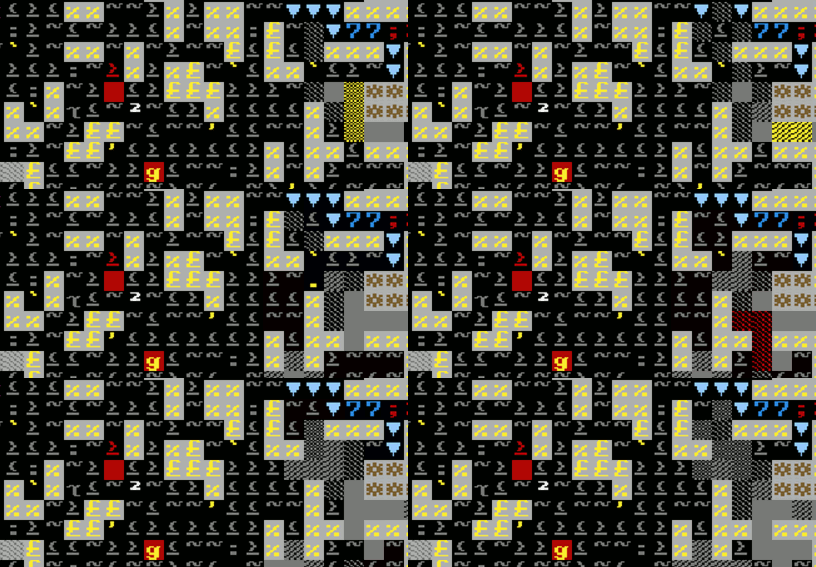
The troops sealed the diorite door. Figul rolled up to the door and stopped there, between the door and the carpenter’s body. At first, it looked like Figul was doing nothing. But as Figul sat, its heat began to change its surroundings. The carpenter’s body caught fire. The surrounding stone heated up, and the nearest surfaces began to glow red-hot. Given long enough, it was possible that the fiery blob would melt its way through the door, and roll into the fort.

The red B is the forgotten beast. The yellow face in a red square is the carpenter’s corpse. The teal “[” is the mussel shell bracelet. The red “_” are the few logs that survived the fire. The colorful tops of giant mushrooms can be seen on the left, growing in a lower part of the cavern.
A Cunning Plan
Argus stayed away from the peephole. A beam of intense blue light was coming in through the hole and lighting the barracks more brightly than the dim candles could. The beam of light, passing through the hot air near the peephole, made rippling patterns on walls and beards.
The soldiers looked at Argus. They would go out there if he ordered it. Instead, Argus said, “Bring me the miners.” He sat on a teal log. A cloud of spores puffed out and settled softly on his steel boots.
Attack of the Miners
“You want me to do what?” Hode the miner shrieked.
Argus repeated, “Go upstairs, above the cavern ceiling. Dig out a room above that forgotten beast, but leave a big lump of rock in the center of the room. The lump needs to be as big as that blob. Then break the floor. The rock will be our hammer.”
Hode remembered the last cave-in she had caused at Argus’ order, while piercing the aquifer for the lead stair. She had survived, but she remembered how the blast had knocked her unconscious. “If that thing moves, we’ll miss. Then there will be a gaping hole in our defenses.”
Argus’ eyes gleamed, “Don’t miss.”
The Diorite Hammer of Alegate
It took days for the miners to prepare the attack. The forgotten beast was still out there. The carpenter’s body had been reduced to ash. The air in the barracks was now as hot as the magma forge-room. Wind had begun to whistle through the chamber.
The hammer chamber was ready. The hammer stone in the center was shaped into a great cube. Someone had engraved text on it. A groove had been cut around the hammer stone to weaken the floor.
Hode and another miner stood outside the groove, ready to slam their picks into the last support. When Argus gave the signal, they broke the support. The floor broke perfectly along the groove, and ten cubic meters of diorite dropped out of the chamber.
The hammer-stone struck Figul Oozelice the Mite of Drool perfectly. There was an explosion of fire that blasted everything nearby. The mussel shell bracelet and copper axe were thrown deeper into the cavern.
Ash and smoke shot up into the hammer-chamber. Hode and her companion were blown into the corner of the chamber and remained there, choking on smoke and dust. They survived.
The forgotten beast did not survive. Nothing of it remained. There was only the great monolith of diorite, a few feet outside the sealed door. The text on the monolith read, “Figul Oozelice the Mite of Drool, 0 – 1054. Welcome to Alegate.”
“Loud, violent, and effective,” Argus intoned.
Reclaiming the Caverns
Lumber harvesting resumed. When a group of freakish bats menaced the workers, soldiers sallied from the deep barracks and quickly killed most of them. Two monsters escaped into the ashy cavern wasteland. The soldiers gave chase, and made a bloody mess of one.

Near the silent lake, the lumps of ash (gray) were interspersed with areas of sand (yellow.) A few colorful plants had begun to sprout from the ash. There were stalagmites containing rich gold deposits.
Pursuing the last monster deeper into the cavern, the soldiers saw a dangerous blind cave ogre. Uncertain they could defeat it, they regrouped to guard the diorite door until several giant mushrooms had been felled and hauled inside. Then they returned to their barracks, and sealed the diorite door.
Other Things That Happened
- Fisherdwarf Datan was posessed by inspiration, and created a legendary earring. He used local stone with mako shark leather from last Spring’s human caravan. It bears a design with three giant beetles.
- Ral the Astronomer is visiting Alegate. In the past year, she has written two original works: “Commentary on Eclipses” and “Do We Understand the Origin of Rainbows?” These are now available in the library. Baron Maltose was seen personally reading the former.
- In turn nine, Alegate produced a lot of wealth. In these two seasons, Alegate produced about 33% of what had been produced in the first 18 seasons combined. This was partly from the collection of adamantine ore, and partly from processing the Roc; just the roasts made from the Roc’s lungs were worth 3% of the entire wealth Alegate had produced up to that point.

Looking Ahead
The Queen’s mandate to the founding council was to bridge the rivers and build a fortress that could hold the crossing. Now Alegate’s military is strong, many are armed and armored with steel, and soon godmetal gear will be forged. Gold is being left indifferently in the mines.
Alegate is becoming well-known. There are often dozens of visitors in the Drowned Langur. A monarch has visited, the elves have sent their ambassador, and the forces of the skinless gecko have tried an attack. Monsters out of legend have seen Alegate’s promise, and have tried to extinguish it.
With the completion of the barbican, the only unfinished part of the surface fortifications is the south tower. With fulfillment of the Queen’s mandate so close, it is time to think what finishing gestures should be made before Alegate is completed. Is there some personal goal your character would see achieved, or some final construction, or some step the fort should take? Announce your wishes in the post comments!
Here are some maps of the current situation on the surface:

Ground level. The northwest and west secret tunnels rise up through the ridge west of the fort. The southwest secret tunnel hatch (¢ in a blue square) is near the cluster of ponds at the south edge of the map. The new fair grounds are north of the fort, lined with goblinite statues (brown Ω). There is a memorial slab (white ∩) where the Roc fell.

One level above ground. The tower-top archer positions are at this level. There was no aboveground woodcutting this turn, so the trees are starting to refill the clearings. Some new trees have grown up against the walls and towers.

Two levels above ground — treetop and roof level. The archer positions are roofed. Each roof has a hatch that was used for access during construction.
Pingback: Monstrous Powers - Dwarf Story
It is a confounding honor and a dubious blessing to have been elected mayor of Alegate. It shows, if anything, that while tyranny is both unjust and destined to fail, democracy is fraught with as many poor decisions and pitfalls as a lonely dwarf looking for love late at night in the Drowned Langur.
Nevertheless, I suppose we must all take our turn in the barrel, as our brothers that sail the seas might say. So, er, have at it.
As for improvements in the coming year, here are a few proposed ideas:
(1) Improved defenses against sieges: the last year saw our brave soldiers face down two legendary (and in the case of one, very tasty) beasts. I’m concerned that our renown will attract even more attention in the future. Therefore, I propose the construction of large weapons capable of repelling fiends from the air or on the ground. Possibly a ballista or catapult. They might be placed on the towers and configured to create crossfire. They will need ample ammunition at the ready and trained engineers to operate them. Also, a dwarf gets to wondering whether there a way to tap into magma and bring it to the surface as needed as a weapon or trap?
(2) Improved transit through the fort: we seem to have been hampered by the size of our establishment, making it difficult for soldiers that are deep below to respond to crises on the surface (and presumably, visa versa). I propose a lift of sorts be constructed. This would be a shaft or multiple shafts (it need not go straight down, I’ll leave that the architects) in which a platform could be placed and raised and lowered along a stout cable and a series of pullies and gearworks. This could also be used to facilitate movements of goods up and down through the fortress.
(3) Clearing around the fortress: Lastly, I recommend that we make sure that we maintain a wide clearing around the fortress. That means trees that have grown up next to the towers and walls should be removed, since they are security threats. Perhaps if magma can be brought to the surface and kept in a trench, we can create a magma moat that will direct potential attackers to a single entry way to the fort. (I realize this may not be possible or may be too big an undertaking – but at a minimum, we should make sure our archers have clear shots at approaching enemies.
Also, we should replace the poor yak that was torn up by the Roc.
“…a confounding honor and dubious blessing…”: nicely put! 🙂
Ballista and catapult: we can do that!
Tapping into magma: that can be done, with a great feat of engineering. Such a feat may require more than a year of work, depending on the scale of the process…we will see what we can do. If managed, it could be a devastating weapon, or create an impassable barrier. A lava moat would be the pride of the realm.
A lift: a personnel lift is currently beyond the art of dwarves. However, we could make a bulk cargo transit system involving mine carts. That would be a feat of engineering. The dwarves will look into where the economy is bottlenecked by goods transport, and plan accordingly.
The dwarves will make sure no tree compromises our walls or fields of fire.
And yes, good idea to replace the alarm-yak. It will be done.
The new Duke of Alegate could not help but to become thoughtful and contemplative when he had a quiet moment to consider all that had transpired since that crisp spring day a few short years ago when a small group of dwarves first began to dig into the riverside muck where a sturdy fortress would soon stand atop a marvelous delving and bustling new town. Her Grace the queen had shown enormous foresight in locating her new colony where she did. Of course, it would not have succeeded without the steadfastness, bravery and extraordinary ingenuity of its inhabitants.
Duke Maltose reflected on the startling turns of his own career path with considerable wonderment at how a mere tradesman could attain a noble title. He worried constantly that he would be shown to be an unworthy fraud and this nagging worry is what drove him to make every effort to be worthy of his position. He wanted so badly to do the right thing in the name of fairness, justice, and prosperity. He was keenly aware that history itself would be the final judge of his actions and that the fates of hundreds of dwarves could depend on making the right decisions.
So it was with with enormous relief and gratitude that he enjoyed the first of many roc meat dishes. There would naturally be a legendary feast to celebrate the defeat of this legendary monster. Also, naturally, this feast would require a legendary ale to go with it. We must be sure to set some aside for the queen’s next shipment. The Duke determined that there would be an annual shipment of Alegate’s best goods to the capital in tribute to her majesty.
The roc was hard enough, but it was truly astonishing to see Alegate’s heroes defeat still another legendary beast, one with terrifying powers of destruction. It is a credit to dwarfish engineering that we created a strong enough door to keep such a monster at bay, and yet a greater one to devise the method of the creature’s doom. Maltose was most impressed, and proud to call himself an Alegater. He was so moved by these acts of heroism, that he decided that those who selflessly acted with ingenuity, bravery and steadfastness should be rewarded. Some of that spare gold should be crafted into medallions in the shape of a miniature mash rake/axe symbolizing the vitality of the town that would be presented to these exemplary individuals along with an honorarium to keep them in comfort for a good while. Maltose would present these personally on the occasion of a feast day, when their meritorious deeds would be told for all to remember.
Additionally, he decided that the first day of spring would mark the founding of Alegate and this should be observed with an official feast day each year.
The fortifications above are coming along nicely. The Duke thought the escape/sally tunnel network was a particularly good idea, greatly increasing the flexibility of our forces’ ability to strike and reconnoiter. He expected that Fark as mayor would be especially aware of ways to keep our defenders safe from outside threats, expanding on Mayor Thornbeard’s capable planning.
Still, the Duke considered the keep to be more or less a large elaborate doorway. He like most dwarves was more comfortable below, and he perceived a great deal of new territory to claim in the caverns. They were full of useful resources and now quite a bit safer. We should consider expanding our underground holdings with further fortifications, walling off new living and working spaces in the caverns that could be easily defended, with a series of sturdy doors we could retreat behind should the worst befall us. After all, as much as we enjoy delving, claiming existing space would be that much easier, and would be an easy way to accomodate a growing population.
Maltose held and admired the carved roc bone figurine with its little coffins and thought about the inevitability of death with a growing sense that the real coffins in the colony would not be filled too early or through carelessly squandered lives. He thought of what had already passed and of the resilience and might of a united group of dwarves, and he thought of the wealth of the delvings and of the possibilities that all of these things presented. And he took enormous comfort in these thoughts and they strengthened his resolve.
It is good to see how our Duke thinks!
Summarizing the actionables for my own notes:
Roc feast with legendary ale – check!
Annual tribute, including ale to the Queen – check!
medallions in the shape of a miniature mash rake/axe – check! Dwarves treasure things made of gold. Also, this means fewer of those gold nuggets for the miners to stumble over on their way to the godmetal mine.
Official feast day commemorating foundation of Alegate on first day of spring – check!
Claim territory in the caverns – doable! Dangerous creatures wander in from distant parts of the caverns, but we can wall off some near areas for worker safety.