
Spring and Summer 1052, in which the defenses take shape, and a new frontier is discovered.
Pages from the Journal of Nac, Human Bard
First Encounter
I was sitting in the strange sapphire grasses at the edge of the Western Mountains. There are unicorns and feather trees in those lands. An old man resting his legs can marvel for hours at the sights of that place.
Behind the susurrus of the soft wind, I heard distant sounds. I thought at first it was the whispering of a fairy, or the grumbling of a mountain gnome. But it was the sound of industry, softened by distance. I followed the sound up the mountain, away from the enchanted lowland.
I met dwarves long before I reached Alegate. Four crossbow-dwarves, wearing bright copper breastplates and helms, saw me as I huffed up the mountain. Around them were a few dogs, who eyed me warily, but stayed by their masters. These dogs looked like they would leap at me in an instant, but were held back by iron bonds of loyalty to their masters. Woe would befall any who threatened these dwarves in the dogs’ sight.
The patrol was cautious, but polite. I explained that I was a man of the Vigorous Confederacy, come to visit the westmost outpost of the Granite Abbey. They pointed me toward their home, and continued on their patrol. I watched them walk for a moment. Their quivers were langur hide, with the fur still on. Their clothing looked ragged. They had shiny copper flasks that matched their armor.

The Walls of Alegate
Alegate is perched atop a canyon. The chasm protects the south and east sides of the settlement. The west side is protected by a deep river, which thunders down as a waterfall into the chasm.
The gap had been bridged in two places by sturdy bridges of blue stone. They must have used their dwarfly arts to find this blue mineral somewhere in the heart of the mountain, for I have not seen its like on my sojourn up the mountain. I walked to the side to gawk at the architecture, and discovered that the bridge-ends near the fort were built upon great stone gears. I did not see how the machine worked, but they must have devised a way to raise these structures should they need to deny passage.
In the distance, I could see the foundations of towers and walls being laid in. The north side of Alegate is the only side not protected by river or chasm, and the dwarves had a plan for that. The site was milling with laboring dwarves. Squat figures hauled yellow stone blocks to the walls, and sturdy woods-dwarves carried firewood down a ramp into the earth. The laborers moved between livestock — cattle, alpacas, and many other sorts — that were crowded between the walls. Smoke rose from furnace-chimneys. Standing in the middle of all of this was a fellow that I later learned to be Hana, architect of Alegate.
I imagined what this place would look like when complete. They were using some sort of yellow stone for the walls — again, a stone like none I’ve seen on the ground here. The avenues of the place were made of a pale stone that sparkled like dew on glass. When this work is completed, it will be a magnificent fort in the wilderness. I am an old man already, and fortunate to have seen so much in my life. But, gods and monsters willing, I hope I live to see this place finished.

Feeding The Fortress
“Watch yourself, stretch!” called the gravelly voice of a dwarf. I stopped where the waist-high grass gave way to a mat of maple leaves, and watched this dwarf approach. She was hauling a large salmon over her shoulder like a log. It looked as long as she was tall.
“Cage trap there,” she explained, thrusting her chin at the maple leaves before my feet. I saw nothing, but I put my trust in her and followed as she avoided the leaves and clomped through the grass. A clump of it brushed her face, and she sneezed. She tried parting the grass before her with the salmon’s nose, like a plow.
I tried to make conversation. “Good fishing here?”
“You betcha,” she said. “I spend more time hauling these down to the ‘Langur than I do fishin’ for ’em. Some of the folks who’ve been here longer say they saw monster fish that could eat a dwarf, but I’ve been here a year now and haven’t seen any. This one’ll be right tasty baked with some of that fruit we bought off the elfs and humans.”
Something she had said confused me. “The Langur, you say?”
“Yup,” she replied. “They call the tavern here ‘The Drowned Langur’.” She noticed my quizzical look and added, “Dunno why they named it that. Prob’ly on account o’ how much brew gets drunk there.”
I’m pretty sure she was wearing langur hide boots.

Words With Guards
Once across the azure bridge, I spied another dwarven patrol arriving from the far bridge. These were armed like the ones I saw before, but had no dogs. One of them had her copper helm off. She had a lot of blood on her neck and shirt, but she and the rest of the patrol seemed to be in boisterous good spirits.
I humbly enquired what adventure they had just experienced. The had spotted a troop of langurs coming to steal from the fort, and had defeated the beasts in the forest east of the bridge. “First time we stopped those buggers afore they could get into our works!” one boasted.
“Me helmet saved me!” said the bloodied one, brandishing her headgear. “Praise Escott! Critter would’a eaten my face!”
I asked them if aggressive langurs were the main danger here. They sobered and related how a pair of kobolds with big knives had recently made it across the bridges before being spotted. They also said they were keeping an eye open for a kidnapper that was lurking in the area, but who had not been spotted yet this year.
“Now that the fort has enough dwarves, we’re finally able to keep squads of archers on patrol. If those sneakers come back, we’ll be ready for them. But we need the wall up, lest we see another werebeast. Rivers don’t even slow those things down.”
The oldest said, “Let’s get Dastot to the surgeon.”
The wounded one, sobered by the thought of werebeasts, added, “and lets stop by the forges, and see if they have that steel ready for the rest of our armor yet.”

Fungus and Moss
Down the ramp, I expected gloom and bare rock. Instead I found myself in a kaleidoscope. Strange mushrooms and mossy growths covered every surface. Someone had shaped the clay walls into oil lamps, and rows of the dancing lights led my eyes deeper into the caves. Beneath the lamps, dwarves bustled to and fro, going about all the industries one would see in a city. Every archway led to something I did not expect. There were too many surprises to list.
At one point, I found myself standing in a military training area. One of the soldiers, a goblin with a battle axe, had stopped for a moment to pet a kitten. I asked her about the colorful growths.
“Miner was prospecting for more ore,” she replied. “He mined his way into a living cavern. He walled up the opening right away, until the Council decides what to do. A month later, everywhere with moisture looked like this. He must have gotten some spores in his beard.”
We both watched as a dwarven soldier, drenched with sweat after sparring practice, sat against a wall. He picked a purple mushroom off the wall, rumbled, “Ooh, wild plump helmet!” and gobbled it up.
The goblin looked sidelong at me and smirked. “Dwarves.”

The Silver Chair
Farther into the delvings, at a place where the plant-bearing clay gave way to clean, gray stone, I came across a dwarf sitting on an ornate, silver throne. He was just sitting there, in the hallway. When I asked he explained that the citizens had all decided that they needed a mayor, so that they would have someone in charge of hearing complaints and meeting dignitaries. For the first term, they had elected their expedition leader, Argus. Then they had begun constructing state chambers with the best materials they had.
“So why is this throne in the hall?” I asked.
“This thing is heavy! I don’t know whose idea it was to put the forges and mason shops way up here, but first we wear ourselves out carrying rocks up from the mines, then we carry them back down as furniture and whatnot. Whoever’s idea it was, you can be sure the mayor is going to get an earful from me!”
He was getting more incensed as he ranted, “And that’s not all! Most of us haven’t prayed since we got here. There’s no place for it, by the gods and monsters!” He made the warding gesture of The Earthen Denomination, a popular religious group in this part of the world. “In fact, I’ve had enough of this. Someone else can move this chair. I’m getting a drink.” With that, he leapt angrily off the throne.
At that moment, a hauler moved past with something incredible. It was a great stone mechanism, festooned with violet gems. On one of the great gears, there was a scene of seven dwarves travelling with a cart. Above them was the inscription: “Alegate, founded 1050.” The hauler was carrying the mechanism ceremoniously, himself enchanted by the work of mad genius.
The once-angry dwarf was soothed at the sight. The fury left him. That seemed to irritate him. “I’m still not finishing this job,” he grumbled, and walked off.

The Tavern Triumvirate
I had been impressed by the bustling workshops of the clay delvings, with all its riotous plant life. The Drowned Langur, with its intricately engraved walls and deep red tables, was a whole different kind of impressive. Citizens spent their free time here. Mixed in were visiting soldiers and performers of varying races. Pets were also present — puppies, birds and others. One particularly battle-scarred, toothless dog was lapping turkey stew out of a bowl. He had the same colors as the marksdwarves’ dogs, but looked older.
At the center of it all were three Council members who had made it their business to get to know the citizenry better. They were greeting each citizen who passed near. About half the time, they already knew the name of the citizen, and were able to follow up on old conversations.
There were dwarven couples there, two of which had newborns. Dwarves are famously stubborn; it can take them years to accept they are in love, and once in love they will never end that relationship, or start another.
To the side, I could see doors to private rooms available for long-term visitors. They looked much nicer than the citizens’ communal sleeping area up in the clay-delvings. In one conversation, I learned that seven mercenaries and four performers had asked for work here in the past six months, and been welcomed.
It is this place — The Drowned Langur (I really must ask about that name) — that made up my mind. That very evening, I was meeting with the mayor in his chambers, being granted performer work. I noticed that the silver throne had not arrived yet.

Wrap-Up
This turn, the the focus for Fark, Thornbeard and Maltose was to meet and get to know the citizens. They are learning more names (each knows between 50 and 80), and have built up relationships ranging from “passing acquaintance” to “friendly terms”. So far, they only consider their 6 founding comrades true friends. The more time they spend in the tavern, the more these relationships will develop, but it could be years before that progresses to marriage. Or it could happen next month. It’s also possible that it’s just not going to happen for some, depending on the compatibility of those in the fortress.
Even if it doesn’t happen, they’re all building their social skills, which will accelerate the process. Who knows … one of them may be mayor some day.
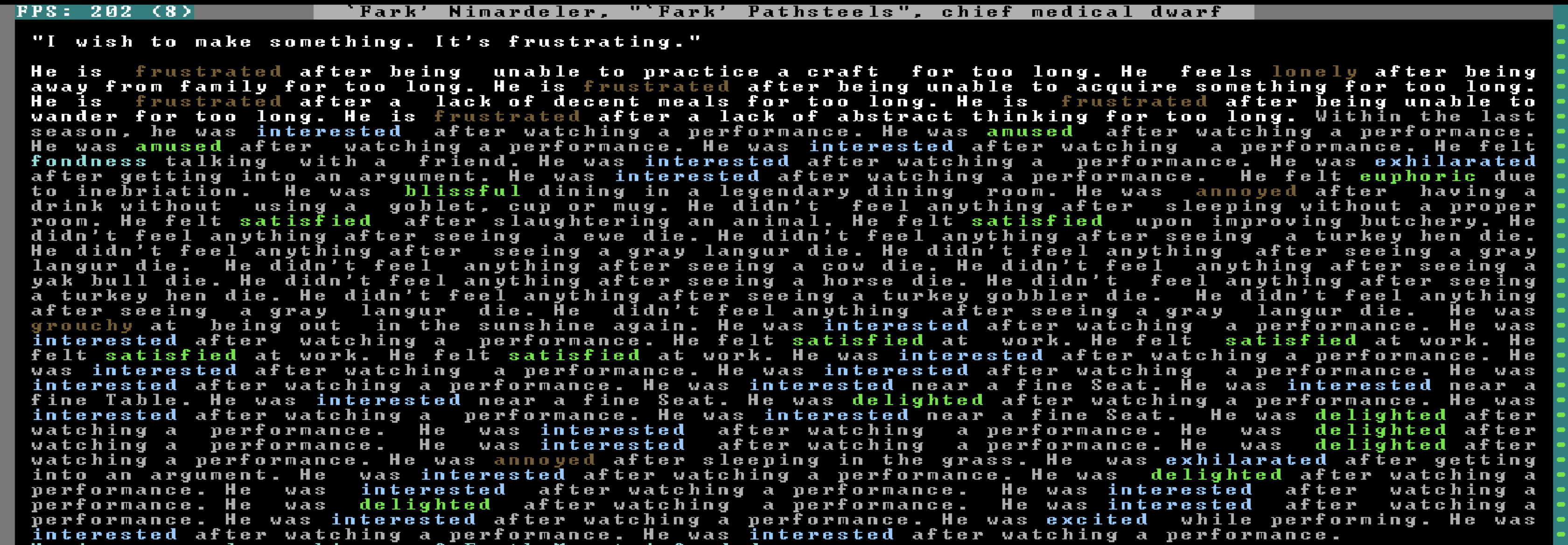
In the mean time, even if the screenshots below happened to be taken while the dwarf was thinking about family, each has their own set of personal needs. Their overall happiness will depend on how well those needs are met, combined with passing thoughts such as sleeping in a nice bed or getting caught in the rain (most dwarves hate rain, though they find being misted by falling water enjoyable.)
- Argus, brawler & mayor – mood – thoughts
- Escott, metalsmith – mood – thoughts
- Fark, surgeon – mood – thoughts
- Hana, architect – mood – thoughts
- Maltose, brewer – mood – thoughts
- Thornbeard, ranger – mood – thoughts
- Fortress status here
-

- View above ground level, showing wall-tops and tree-boughs.

-

- Orthoclase walls, quartzite roads, microcline bridges. The refuse pile has been moved farther away, to avoid upsetting guests.

-

- Layer 2. The cavern-plants have taken root so well that animals could graze here.

-

- Layer 7. Rovod the ranger, who is too quiet a dwarf for the military, has taken up training the langurs and ravens who were caught in cage traps. They will never be completely tame, but if we allow them to breed, their offspring could be domesticated. A zoo and cage storage has been added east of the tavern. More visitor rooms have been added to the inn.

-

- Layer 9. In the west, a suite is being prepared for the mayor (Argus at the moment.) Thornbeard’s private chamber is in the east. It has walls of natural quartzite and cobalttite. The bed is made of bayberry wood. Microcline was used to build the door, coffer and cabinet.

-

- Layers 18-25 (showing layer 25.) Natural cavern, with many stalagmites. Precious minerals can be seen in the walls. It is carpeted with mud and plants, and crawling with small creatures — lizards, cave birds, and cave spiders. The tiny cave spiders are not deadly, but a bite from one can mean a dwarf experiences occasional faintness for the rest of their life. Their webs can be made into fine silk. This is an isolated cavern, with the only way out submerged in water. Nothing large has come in through the water (yet.)













Argus grimaced at the hallway, standing on the back of his new throne, having the labor dwarves slant it so he could achieve maximum heroic posture. “I think that, after we finish this project, we should move on to something more practical. We shall forge an elevator to take us from behind a guarded post near the entrance to the lower levels of our fortress. And to prove our glory, we shall forge it of the densest material available.”
The workers groaned, but continued to move.
Primary Directive: Investigate, or begin, construction of a elevator, or expedited movement system.
A fine idea! Now that we know the aquifer is only one layer deep, we can dig out the saturated sand in an area and collapse the clay layer into the gap. That will give us a dry gap in the aquifer so we can build a stairwell that takes us more directly between levels. That project involves dangerous digging into saturated soil and a potentially deadly collapse of tons of Earth, but the dwarves are good at that kind of thing.
Haulers spend lots of time just travelling right now. For example, every plant they harvest on the surface has to be carried through that long clay hallway. Then after the Brewers are done with the plants, the newly extracted seeds have to be carried though that hall back to the surface…and there are similar inefficiencies with other industries. A direct stair will be a vast efficiency improvement.
Also, bonus points for striking an heroic post on the silver throne in the hallway. 🙂
Side note: the dwarves have not been able to manage an elevator yet, but they can do mine carts. Mine carts are great for moving large quantities of a thing from point a to point b. That has to be set up carefully because dwarves and animals getting hit by moving mine carts is bad. But making it so that (for example) a soldier can get from the tavern to the surface quickly is a job for a stairwell. So we’ll go with stairs for now.
Oh…another thing. We happen to have a lot of lead as a byproduct of smelting the galena to silver. We’ll see about using it for the stairs. I’m sure the haulers would rather tread on lead than carry it.
That is, unless someone starts using the lead to craft miniatures and toys for the children. 🙂
Pingback: Turn 8 - War and Diplomacy - Dwarf Story