
By order of the Queen of the Granite Abbey, seven brave settlers had made the long journey to a wilderness in the Eastern Mountains. Their duty was to build bridges over the deep rivers here, and construct a stronghold to guard them. The place would be known as Alegate.
More migrants would follow, and the seven were destined to be the ruling council of this place. They were known as:
- Argus, brawler and bonecarver.
- Books, book keeper and amateur carpenter.
- Escott, metalsmith.
- Fark, butcher and surgeon.
- Hana, architect and mason.
- Maltose, brewer and cook.
- Thornbeard, ranger with skill in crossbow, hunting and foraging.

The site for Alegate, as the Council arrives.
Supplies
The supplies they brought, aside from the clothes on their backs, included:
- copper pick x2
- copper battle axe
- dwarven rum x40
- dwarven ale x20
- Underground crop seedstock
- plump helmet spawn x5 (edible, brewable)
- pig tail seeds x5 (processable into thread, cloth)
- cave wheat seeds x5 (edible, brewable)
- rock nuts x5 (editble, processable into oil)
- pond turtle meat x15
- plump helmets x15 (the edible fungus from plump helmet spawn)
- pig tail thread x4
- pig tail cloth x5
- pig tail bags x5
- pig tail ropes x3
- eagle leather quiver
- ashwood bucket
- ashwood splint
- ashwood crutch
- ashwood wheelbarrow
- goat meat x15
- gypsum plaster (for medical casts)
- copper crossbow
- copper bolts x39
- iron anvil
- a breeding pair of dogs
- a breeding pair of cats
- a chicken and rooster
- a horse
- a mule
- a wooden wagon
Note that dwarves prefer to consume one unit of drink every three weeks, and one unit of food every month and a half. Longer than that and they become unhappy and could eventually die. Note also that dwarves are perfectly capable of staying hydrated with booze as their only drink. They will drink water if there is no booze, but that is bad for morale. If dwarves go too long without food and drink, they will try to find ways to survive, but that gets ugly.
Spring
The dwarves felt they needed an official expedition leader, so they elected the one with the most developed social skills. Given the complete lack of developed social skills among the the dwarves, they went with the one with the best scowl. That was Argus (he had some formal training in intimidation.)
Books took up the axe and felled the trees between the rivers.

Drama in the river
Thornbeard got the dogs together and began training them to help him hunt.
The cats got started killing every small animal they could find. Rat corpses started piling up by the wagon.
While others penned the grazing animals, broke down the wagons, and stacked lumber, Hana and Escott took up the mining picks.
The Trouble With Sand
Leaving the supplies aboveground was not an option. Aboveground, the supplies could be raided by animals, monsters, and enemies.
The pick-wielding duo dug a ramp down into the earth, near where the tributary fell into the river chasm. They made the ramp wide enough to accommodate a wagon (a caravan was expected in Autumn.) The plan was to delve into the stony bones of the mountain. They dug through a layer of loam, then a layer of clay loam. Then they ran into a problem.
Three layers into the mountain, they hit sandy loam saturated with water. The ramp could extend as deep as the chasm, but no deeper — any deeper, and water flowed in to replace the soil.
Hana, the architect and stone expert, made this cryptic monologue:
Aha! Beneath this unsaturated zone lies the local aquifer! For lesser hydraulic conductivity, we must make a connecting tunnel to to roots of that mountainside we see in the west, for surely there lies our aquitard!
When faced with everyone’s blank looks, Hana relented: “Let’s dig over to that rocky place.” Now that he was making sense, work continued.
Thus Hana and Escott took to mining out a space in the clay. The clay would be no good for Escott’s metalsmithing or Hana’s stoneworking. Humans would settle for building homes from this goo, but it was not dwarfy.
 Before spring was over, enough space had been cleared in the clay that there was space for their supplies, some work shops, a small underground farm, and a meeting area. The miners were able to squeeze a tunnel west between the water table and the river tributary, but just barely. The clay beneath the river was wet, but would hold, barring some collapse-inducing strike on the stream-bed.
The dwarves hauled their supplies underground, except for the voluminous lumber. The horse and mule were left aboveground, as they were grazers and would starve in the barren clay chambers. Now that their wagon-pulling duties were over, they weren’t much good to the dwarves. There was brief thought about butchering them, or placing them at the edge of the settlement to distract monsters.

Note the cats – the little “c” marks – “helping” the miners.
Summer
Some workshops were put together:
- brewery / still (first priority!)
- carpenter shop (have to work with wood until there is proper stone)
- kitchen
- butcher shop
- kiln (got plenty of clay to work with)
- wood furnace (going to need charcoal for fuel and ash for soap)
Books put her meager carpentry skills to the test. She made an office for herself, and started counting things and coordinating work schedules for maximum efficiency.
 Hana and Escott found dry stone in the west. They dug probing shafts to find the depth of the aquifer, and discovered that it was not very deep. Only a short stair would be needed to get beneath it. As they went, Books catalogued the following resources:
- limestone – good gray rock, also useful as flux for turning iron into steel
- malachite – copper ore
- kaolinite – red, sedimentary stone that can be used for porcelain
- quartzite – white stone
- orthoclase – yellow stone
- galena – ore of lead and silver
- cinnabar – red stone, especially heavy
- schorl – low value gem
- rubicelle – semi-precious gem
- rock crystal – can be cut as gem, or used in glass-making
Now that they had ores, Escott put down the pick and turned to smelting. Fark, with nothing to perform surgery on or butcher, assisted by turning logs into charcoal.
Thornbeard and Maltose gathered wild plants around the wood piles. Maltose began brewing: potato wine, spelt beer, and bilberry wine from the surface plants. With the underground farm produce, he created dwarven ale, rum, and wine from pig tail, sweet pod, and plump helmet, respectively.
Fark and Maltose spent some of their time cooking up delicious roasts from the ingredients they had brought, grown, and gathered.
Hana used his masonry skills to create stone mechanisms. They would be needed to build machines that protect the entrance from troublemakers.
Migrants
Some dwarven immigrants arrived to join Alegate.
- A married couple — Cerol the weaponsmith and Nedun the glazer (as in pottery and statues)
- Another married couple — Okgush the farmer and Meng the gelder. They brought a child with them — Dastot — who was 11 and about to become an official adult
- Mon the leatherworker
Argus, who had been working as a general laborer all this time (due to the lack of bones to carve) organized the adult migrants into a military squad. The leatherworker and gelder both had military experience, but Argus chose the gelder for the militia captain job, as her attitude was a bit more dwarfy than the leatherworker, who had grown up among humans.
Argus also organized The Council into a squad. Neither squad had official military duties, as there was a great deal of regular work to be done, but a corner of the meeting area was set aside for dwarves who felt the need to practice martial skills. If a time came when a specialized military made sense, then a squad or more could be assigned to train for some of (or all of) the months.
An advantage to having dwarves assigned to military squads, even if they weren’t on active duty, is that the dwarves could choose to carry weapons and armor. One never knows when that may come in handy.
Nedun the glazer began creating, firing, and glazing clay jugs. Maltose was generating booze faster than the dwarves could drink it, and a lot of jugs would be needed!
Autumn
Orders were put in for military gear:
- wood shields x12
- iron axes x8
- copper axes x4 (because there was not enough iron for everybody)
To help with that effort, Fark was grabbing a log to make charcoal when he spotted an enemy!

k = kobold, M = mule, H = horse, c = cat, and Fark is that purple person.
Kobolds are small, primitive, thieving savages that lurk around the edge of settlements and try to steal things. This one was wearing a spider-silk loincloth and tunic. In his hands was a large silver dagger. Before Fark could do anything, the kobold turned around and ran into the wilderness.
Later, the cats produced a pair of kittens, and the dogs birthed three puppies. The adult dogs, having been trained by Thornbeard but never assigned to anyone else, followed Thornbeard, and the puppies followed their mother. Wherever Thornbeard went, the pack followed.
Caravan
A trade caravan from the mountainhome arrived. With it, the Queen’s representative – Bathru – arrived with news of the world. Kidnappings were rampant in the lands formerly held by The Unwelcome Monsters, and the Granite Abbey was sending out missions to reclaim strongholds that had been abandoned over the years.
The caravan itself brought its wagons safely underground, and had every trade good available to the Granite Abbey. Argus had no experience with trading, but tried his luck anyway. Maltose had created a particularly nice roast with plump helmet, minced turtle and spelt beer. Argus traded 16 units of it for things Alegate could not yet produce on its own: dingo meat, glass, spools of thread, and crates of leather and cloth. The traders were pleased with this, Argus learned a bit about trading, and the traders will likely be back again next autumn.
Defences
Hana put his mechanisms to use in defence of the fort. First, he built a sturdy gate at the bottom of the ramp that leads to the surface. Using the mechanisms he had constructed, he linked it to a lever in the meeting area, and the gate could be opened or closed from there. When opened, it would drop flat on the ground like a draw bridge. When closed, it would prevent access, and was strong enough to keep even a troll out.
Beyond the gate, far enough back that they would not interfere with trader wagons, he used more mechanisms to construct a row of cage traps. Friendly people would be able to pass over them safely (provided they did not somehow lose consciousness directly on the traps,) but enemies and hostile animals would be trapped. Some creatures are able to bypass traps, but the cage traps were a good general measure.
There are other traps that can be built — traps that drop a stone, or swing mounted weapons, or attack with specially-built giant corkscrews, spiked balls, or circular blades — but the simple cage traps were a start.
Bridges
A pair of wood bridges were put across the river. Hana architected them, so they were stable, but they were crudely fashioned of wood. They were temporary measures that would give the dwarves access to more of the surrounding area.
Turkeys
Wild turkeys arrived, and Thornbeard set out across a bridge with his crossbow and dogs. He quickly shot and retrieved a number of them, which Fark promptly butchered into cooking ingredients, bones, and fat. Fark had plans for that fat.
One of the hunting dogs ran off and did some turkey hunting of his own. At one point one of the dogs got into a tangle with a turkey, and came out wounded. He would survive, though.

I think this strangely aggressive hunting dog is why dead turkeys can occasionally be spotted in the woods. Thornbeard always hunted them only one at a time, and always brought his kill straight to the butcher shop.
Migrants
More dwarves arrived:
- A married couple – Bathru the bone carver (no, not Bathru the Queen’s representative) and Hode the fishery worker.
- Bomrek the farmer
- Omsos the farmer
- Shorast the farmer
- A married couple – Tista the brewer and Ted the siege engineer
They brought with them a gander and a baby alpaca. Fortunately, these were not pets, so they could be butchered without upsetting anyone. Ganders, being male, don’t have a particular use outside goose breeding programs. Alpacas are grazers, so they need grass to survive, but they can sheared. Being mammals, female Alpacas can be milked. The alpaca was pastured with the horse and mule.
For now, the new migrants were not assigned to any military squad, and so would not spend their free time training martial skills.
Posession
It is a quirk of dwarven psychology that once in a while, a dwarf will be struck with inspiration. This is a once-in-a-lifetime experience for a dwarf. If they are lucky, they will create a fine artifact, that will bring joy to any dwarf who beholds it. If they are unlucky, their inspiration will call for some ingredient they can not acquire, and they will go insane.
Shortly after arriving in Alegate, Ted the siege engineer became posessed by inspiration. She claimed a mechanic workshop, and created “Gallowsdusts the Magical Flax”. It is a malachite mechanism, which can be used in levers, traps, and a variety of other mechanical things. It is encircled with bands of rectangular malachite cabochons, an will inspire happiness in any dwarf who passes near whatever gets built with this artifact.
Chicken Coop
The chickens, who until this point spent their time wandering aimlessly about the fort, were penned with a proper nest box, and the door to their pen was locked. That would keep any hungry dwarves from devouring their eggs. With some luck, there would soon be more chickens.
Winter
The climate at Alegate was warm enough that snow would never fall, and the rivers would never freeze. The climate was as comfortable as any other season.
Forges
Escott and his helpers had been busy in the forges, and the new axes were ready. Having run out of iron, they started producing more military gear:
- copper helmet x12
- copper breatsplace x12
- more copper arrows
Hospital
Now that there were enough hands to help out at the forges, Fark gave up his woodburning chores and applied his arcane medical knowledge to produce something rarely seen: soap. This substance is too rare to be bought from traders, but (according to Fark) is extremely important in preventing infections. It is unknown whether dwarves know that alcohol can also be used to prevent infection. If they know, they must consider it too petty a use for so important a substance.
In any event, he soon had soap made from turkey-tallow and ash.
His next work was to set up a hospital area. It was equipped with:
- a wood operating table
- five beds for recuperation
- a traction table for setting badly broken bones
- a chest containing medical supplies:
- thread for sutures
- cloth for bandages
- gypsum powder for casts
- ashwood splint
- ashwood crutch
The project took a lot of doing, but with the extra hands around the fort, it was done quickly. Fark’s one complaint is that medical emergencies would require laborers to bring buckets of fresh water to the patients; first to clean their wounds, then to keep them hydrated until they were strong enough to drink alcohol. As things stood at this point, water gatherers would have to go outside the defenses, gather water at the tributary, and haul it all the way back. That could be dangerous at times, or impossible during a siege.
Monkeys
Remember that dog who got in the tussle with the turkey? That dog was the first to notice the incoming troop of monkeys. The grey langurs and the dog got into a brawl (it is unclear who started it.) The dog gathered a whole new set of monkey-scars on top of the still-healing turkey-scars, but survived.

The langurs, being fast-moving thieves who seek to grab something interesting from settlements and run off the map with it, got past the dog and closed in on the fortress entrance.
Soon, there were scuffles between monkeys and dwarves around the wood piles. One of the monkeys was spotted running off with somebody’s hat. Argus finally had a chance to use his wrestling skills:

Productivity came to a complete halt. Dwarves would go aboveground to do things like get lumber, fetch water, or to dispose of yet another small dead thing left lying around by the cats. Then they would see the monkeys, forget about their jobs, and either run below ground or chase the fast-moving monkeys around. Monkeys, dogs and dwarves were accumulating bruises and scrapes. Hana, for example:

So the dwarves activated the military squads. That meant dropping all regular tasks, grabbing battle-gear (if they didn’t already have it) and rallying at the wood piles. In a melee of monkeys, dogs, and armed dwarves, things were brought to a quick resolution. An excerpt:

And that was that for the monkeys. No more thieves, no hats were carried off the map, and there was a bunch of monkey meat lying around. No dwarves were seriously injured.
The Night Creature
A note about werebeasts: they are horrifying. The original werebeasts are people who offended a diety, and the diety responded by cursing them with lycanthropy. Sometimes werewolves, some times were-something-else. In werebeast form, they are extremely strong, and ignore pain, so severed limbs and crushed bones will not stop them.
The real terror of these things is their bite. After a brawl with dwarves, any dwarf bitten will likely become a werebeast. Some skilled and well equipped dwarves can probably take the werebeast down in combat, but is it worth risking the infection spreading into the fortress?
With all that said, let us observe the description of the werebeast that raided Alegate in the late winter of 1050:

The Ñ represents the werebeast.
Yes. That’s a werelamb. The historical records have detailed backstory for how this human child was infected by a 500+ year old cursed human, but that is a story for a different post.
The dwarves of Alegate did not mess around with this one. They got underground. Then they reflected for a moment that they had never actually tested Hana’s gate-closing lever. The werelamb was sprinting toward the settlement, jumping clear over rivers along the way. They pulled the lever, Hana’s gate closed as designed, and the dwarves were safe.
The werelamb leapt into the trees, and ran around up there for a while. Then it returned to the ground and started attacking the pastured mule. Most wearbeasts would be tearning limbs off of the mule. This werebeast wasn’t as effective. The mule was in this state, when the little monster turned back into a naked, 9 year old, not particularly violent human:

Nothing deadly, and donkeys are not subject to lycanthropy. Dwarves do not provide medical care to animals, it will just have to heal on its own.
The last sight of the werelamb was its naked butt disappearing into the forest. We may be seeing it again.
Turn Wrap-Up


Fortress status summary at end of 1050. The “other” category under “food” means prepared meals.
Profiles
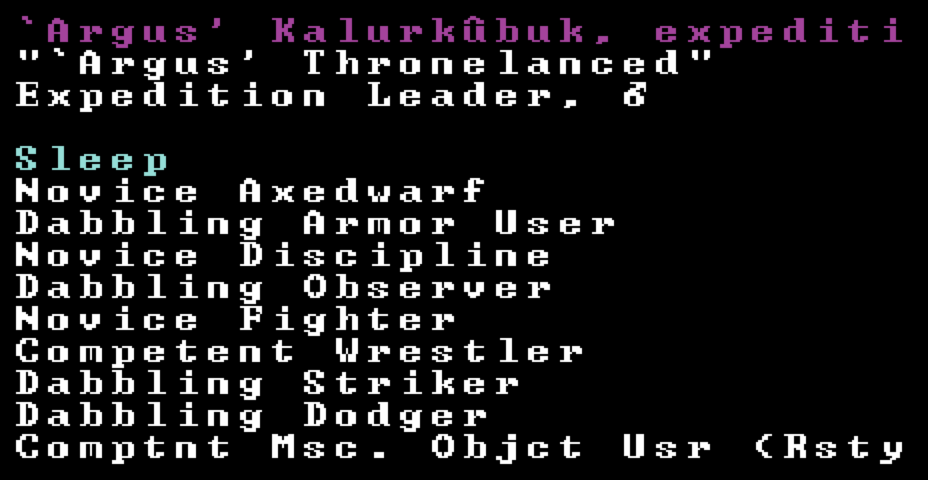
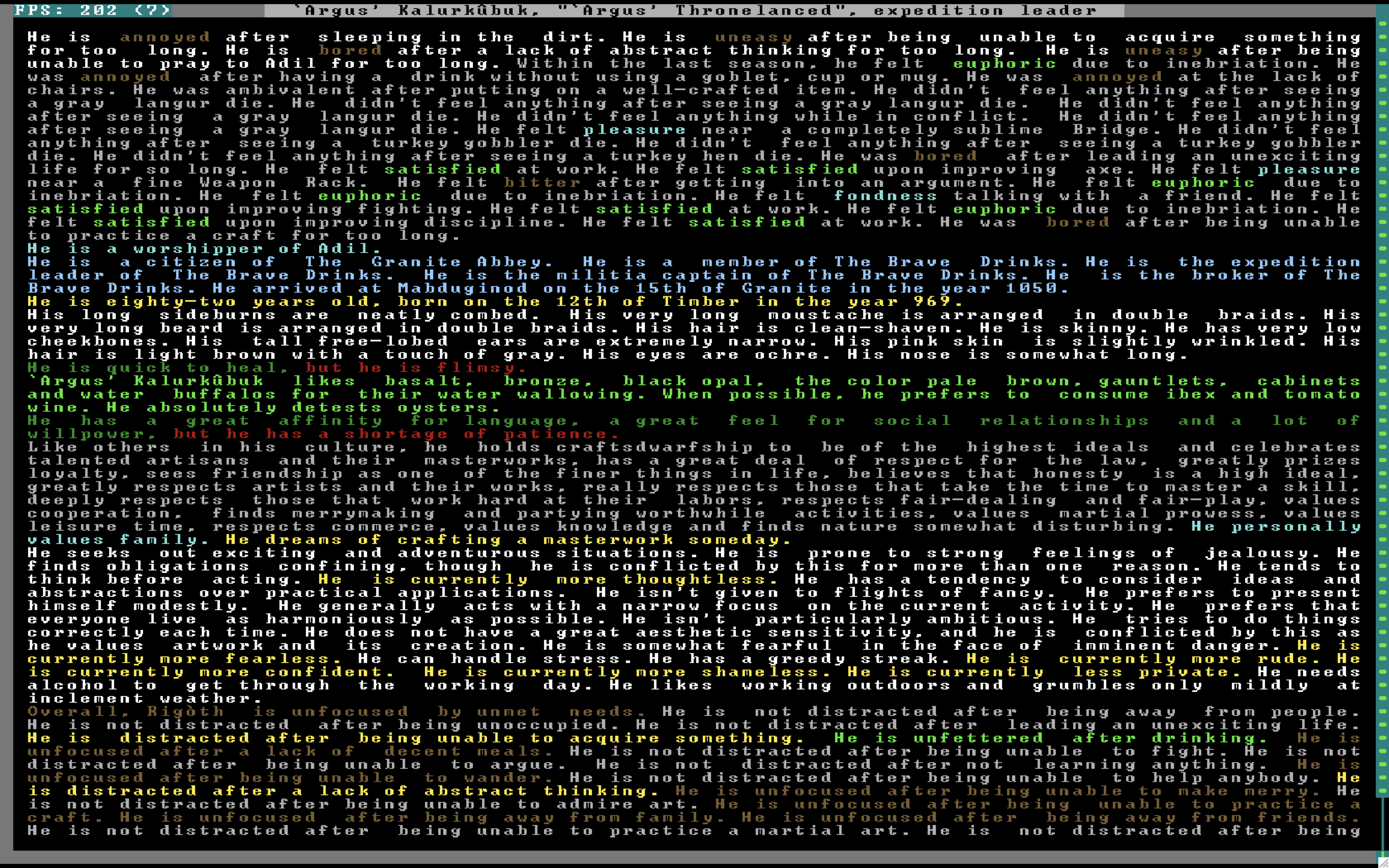
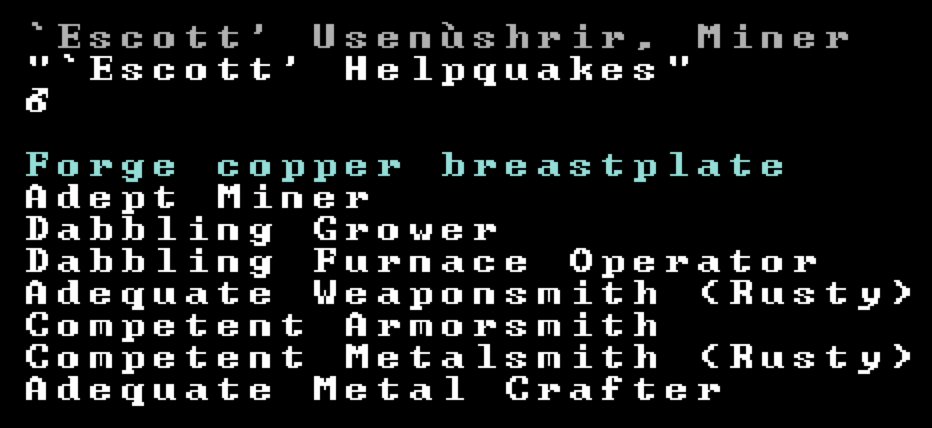
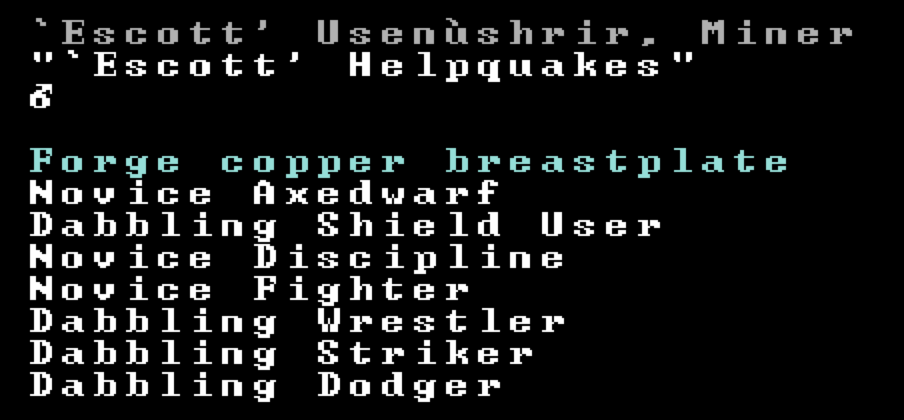
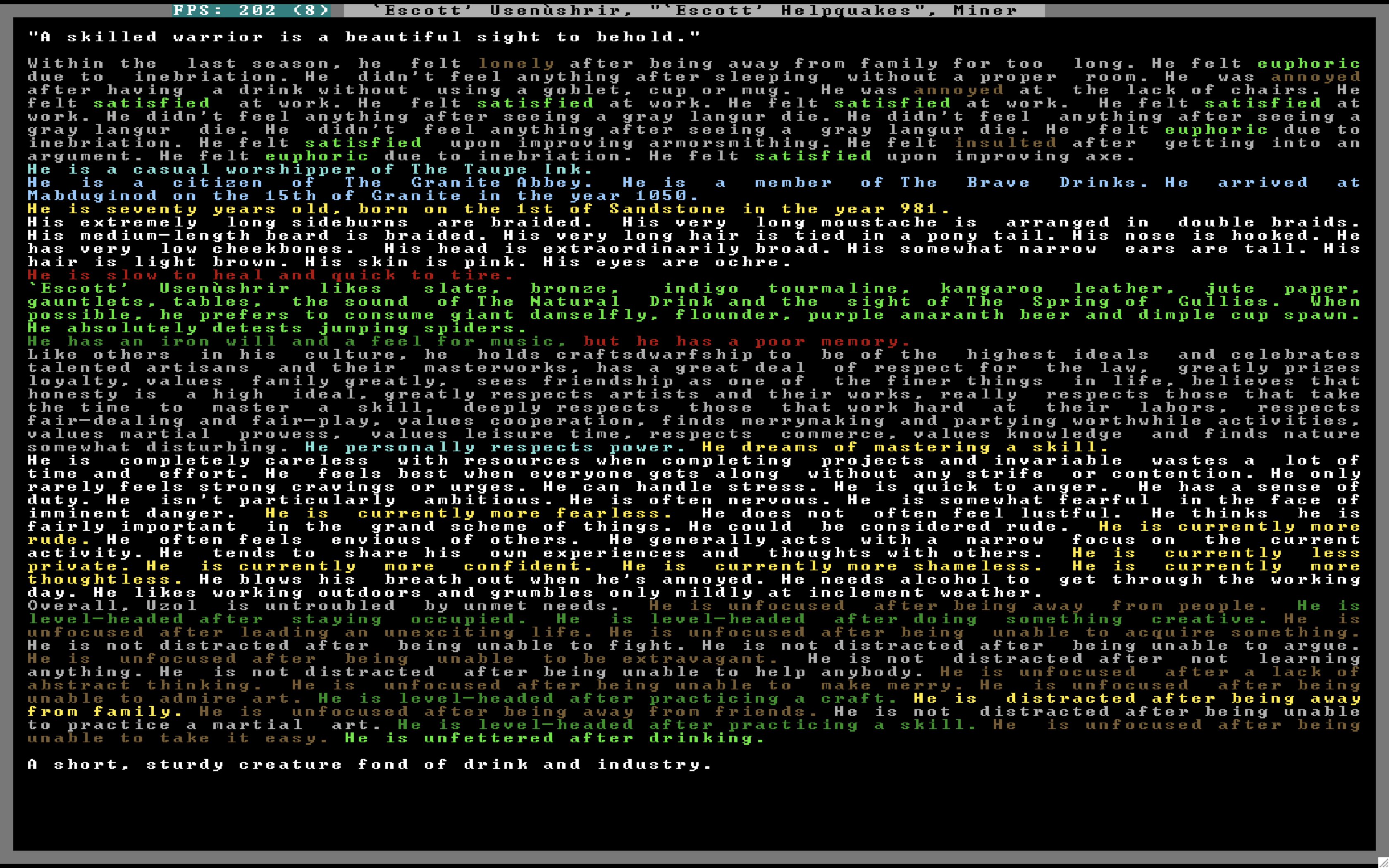
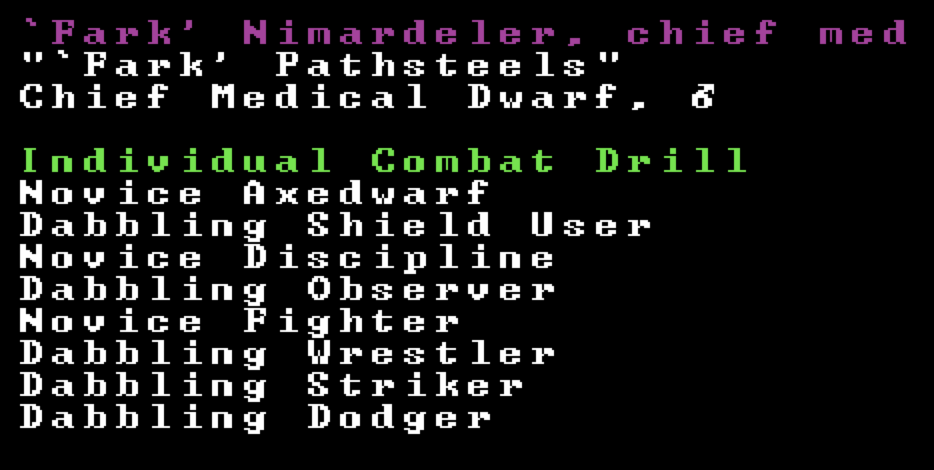
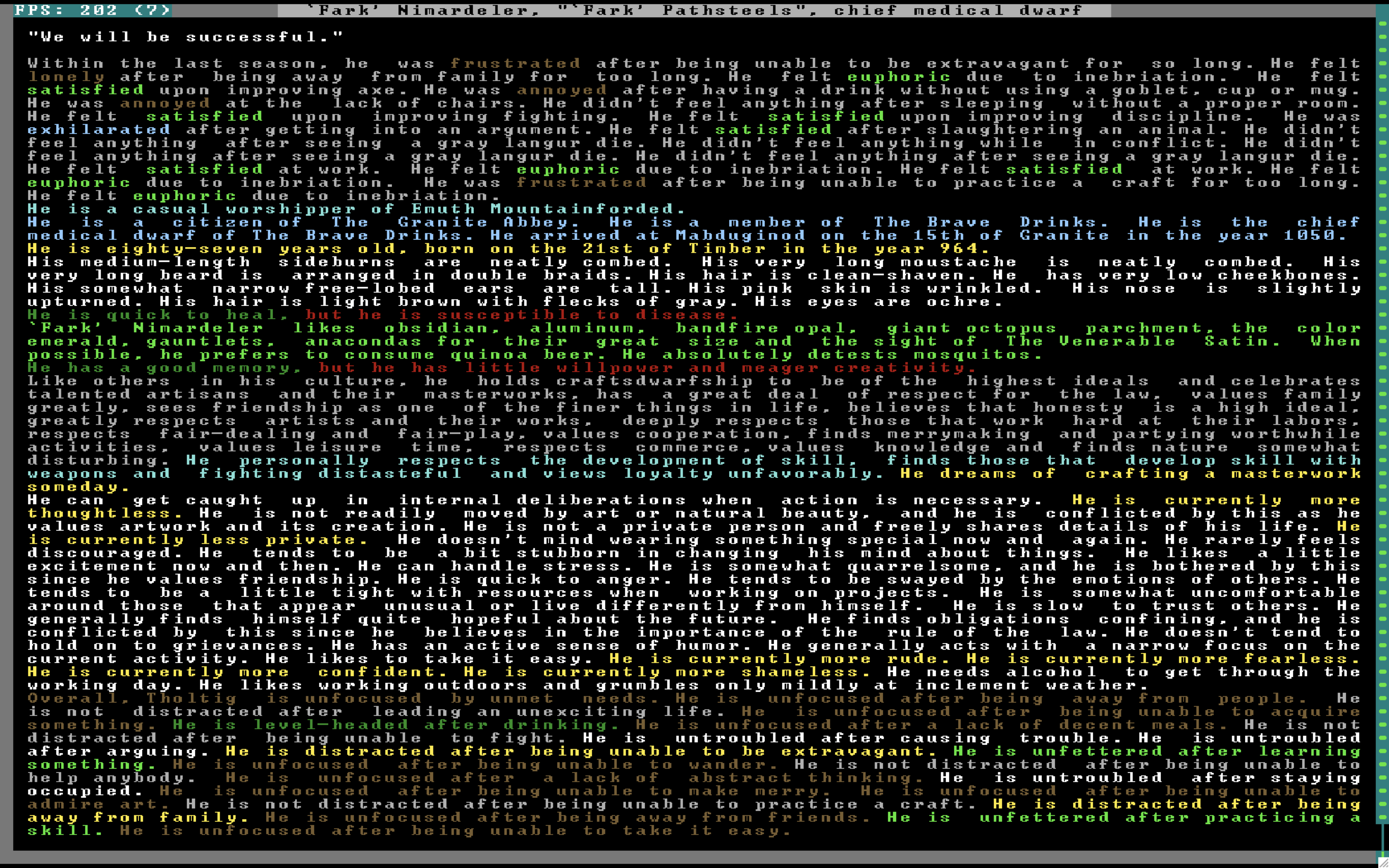
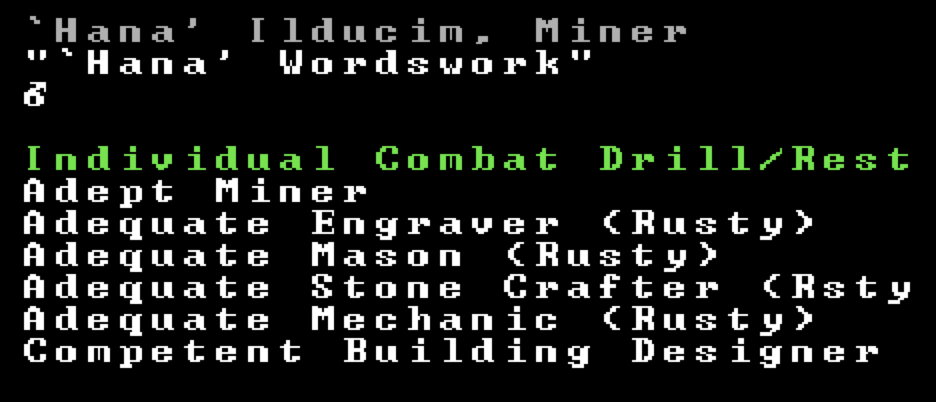
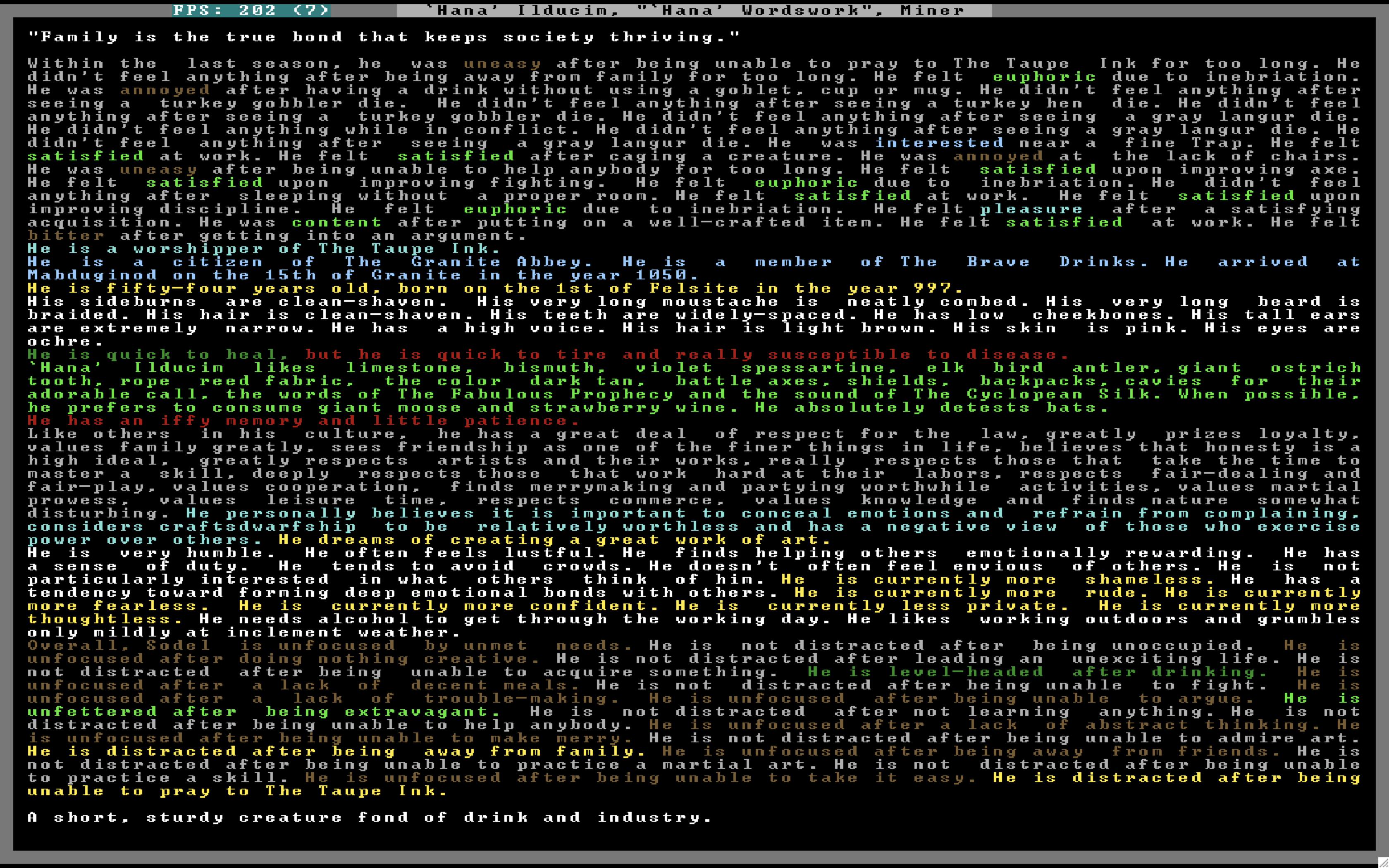
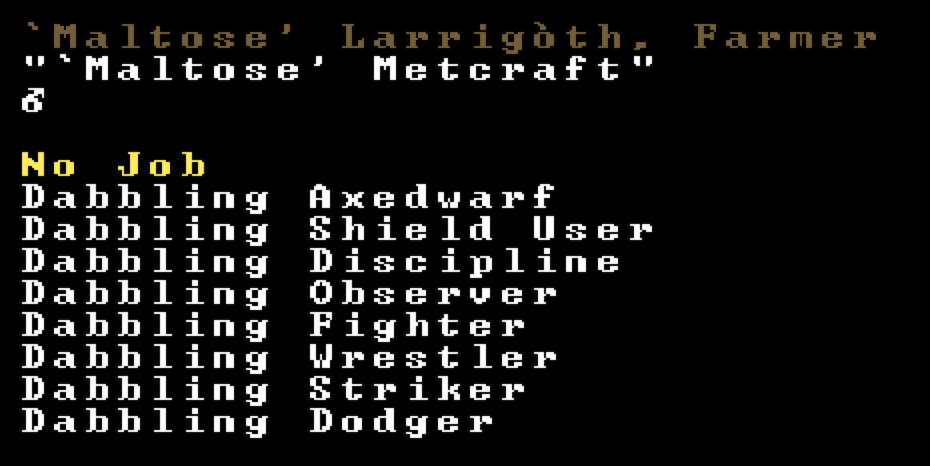
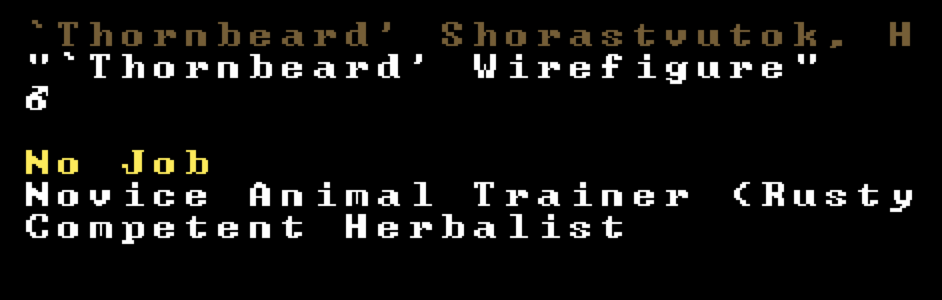
Below is information on how each character is doing at the end of 1050. The lists of trade skills and military skills are pretty self-explanatory. At the top of each list is colored text indicating what the character was up to at the moment the screen shot was taken.
The profile page is…a wall of text. It gives a whole lot of information, from what thoughts have passed through their heads lately (top) to a summary of their emotional state (bottom.) My best advice is just to dive in, and you’ll see how the information is grouped into blocks. If you’re a read-the-manual type, there is an explanation of the various profile page sections here.
- Argus, brawler – trade | military | profile
- Escott, metalsmith – trade | military | profile
- Fark, surgeon – trade | military | profile
- Hana, architect – trade | military | profile
- Maltose, brewer – trade | military | profile
- Thornbeard, ranger – trade | military | profile | hunting







Note to the Players
Wow, this was a long post! The first year contained a lot of activity, with so many small projects for the dwarves to execute quickly. I intend to make the next post shorter, so that it doesn’t take most of a week to get it written (and such a commitment from the players to get it read!) Turn 2 may represent less than a year. It depends on how eventful the next seasons are.
Of the seven randomly-generated personalities in the founding group, I assigned y’all characters based on how well their personalities went with your email responses…but a lot of it is pretty random. Their personalities could lead to the dwarves making decisions during the simulation that don’t quite line up with what you envisioned for your character. Let us embrace this randomness.
Next up: Please comment on this post, letting me know / discussing what your council members would like to do next. Go ahead and be creative — it’ll be up to me to see if Dwarf Fortress can handle what you want. Questions about background, additional info, what is possible, etc. are welcome.
I picked names for some characters. I think y’all will be able to guess which ones are yours. 🙂 Declare here if you’d like any name changes.
Walking through the halls one day, a single drop of water lands on Argus’s head. After smashing the mug he was carrying into the wall, he mentioned that the roof should probably be reinforced, particularly if it is over a river.
He has also expressed interest in forming a “Fishing” team to train in combat so that they may kill, eat, and carve the riverbeasts. He recommends they use langurs and goblins for target practice. Perhaps the offspring of the overly violent dog would prove useful in this endeavor, as companions.
Reinforce hall beneath river – doable!
Fishing team – doable! There are lots of fish in that stream. Should bring in lots of meat. There are turtles in there, that can provide shell for crafts that can be sold or claimed by dwarves to make them happier.
Target practice – doable, if the creatures can be caught in cages and put in a convenient shooting gallery. We can put together an archery squad, and direct that squad to equip crossbows instead of focusing on melee weapons.
Dogs – doable! A dog can be assigned to any dwarf as a pet. The dwarf will name them, and the dog will follow the dwarf around, and the dwarf will get happy thoughts when they see their pets, or become sad if something bad happens to the dog. Also, once the puppies are grown (takes maybe a year) they can be trained either as hunting dogs (sneak when master is sneaking, and runs fast to attack creatures when master attacks) or war dogs (better a melee, and more aggressive toward hostiles.)
(To be clear, he wants to kill the larger angry fish as well as the actual edible fish)
Killain the Brewer here. Maltose is my nickname if ye must know. I know, I know, I acquired a taste for above-grounder beer as a wee dwarf. But don’t be mistaken, I make the best dwarven ale you’re likely to taste. Still, what most dwarfs don’t know, adding a touch of barley malt can lighten the body of the drink, making it a fine breakfast tonic!
Speaking of brewing, my kettles are frequently full, but I can turn out a few more batches of my best during a typical month. We have all we need to drink, plus a little more, which is a good way to be, but I think we can be in even better stead with more ale laid back. I say this is so for two reasons: first, as ye well know, it’s always an eagerly sought barter item and we can profit by it. Second, as food alone may spoil, a hearty ale can be drinkable for months hence, even gaining deeper flavours as it sits! Should the unthinkable befall our food stocks, ale can sustain a dwarf until we gain more food. I daresay, it wouldn’t be the first time I lived on drink alone for a time! To this end, I suggest we expand our farming, seeing as we have gained a number of farmers this past year, to grow more brewing ingredients. Also, I’ll require more storage area and additional aging vessels, either our traditional stone tuns or of the oaken cooperage as the sunlanders favor, perhaps some of both. The woody-tasting ale might be more attractive to traders. Would the delvers among ye help me in carving out a new cellar? I wonder as well if another young dwarf might be a willing brewer’s assistant in exchange for modest pay and an extra ale ration?
Also, I feel an effort should be made to capture that stray hunting dog. The fearsome thought of marauding turkeys may keep us all up at night, but by my reckoning, that dog is wasting food. Should a turkey be killed, that turkey should be et! The dog has clearly shown its ill aptitude for hunting, but since it can yet bark and bay, it should be rightly behind our fences on guard duty.
So far, I feel we have been fortunate in the progress of this outpost, with only minimal danger. However, in addition to Argus’ archer squad, we must have capable footmen to fend of any marauding forces that may come raiding. I will freely join such a force and I’ll bring my mash rake, which is set with blades per the dwarf brewer’s tradition. Those unfamiliar with the brewing arts might deem it a “poleax” but it’s much better than a mere weapon, since you can use it to make beer!
Highly entertaining and dwarfy words!
Great recommendations, all doable.
[Summary if you don’t want to read it all: (1) make some furniture and cups, (2) throw some parties, (3) keep acquiring fats and oils, (4) prioritize soap making, but also use for light to improve security, (5) wash your goddamn hands, (6) dig a ditch/pipeline to bring fresh water into the fortress, (7) cultivate a garden for medicinal herbs and perhaps herbs and spices to flavor food and trade, (8) recycle turkey feathers and furs for arrows (the feathers) and/or target practice dummies to train attack dogs.]
Listen, gentledwarves, we should be proud that we survived out here for a year, in the hinterlands, surrounded by thieving monkeys, rapid turkeys, and the occasional werebeast, despite its wee size.
That said, we will continue to live like goblin squatters until we get some gods damned basic necessities around here. For one, we need some goblets or cups. I suggest we craft them from the langur skulls and other bones, until we find something more suitable. Also, chairs. Look, I don’t even need a god damn chair. A stool. Just something to rest my weary ass on. If I have to have one more meal sitting on the floor and scooping up drink with my hand, I may weep. Weep, I says! Weep. Maybe we should just think about some furniture in general.
Speaking of wellbeing and happiness, once we have some cups and chairs like civilized folk, I recommend that we celebrate our successes to date, perhaps with an anniversary party of our fortress’ founding. There should be food and drink aplenty, revels, games. More drink. Frequent drink. You get the picture. We should probably do something like this on a pretty regular basis to keep up morale.
Our reserves of fatty oils from slaughtered animals have been well built, but we need to maintain them. I would prioritize continuing to provide soap, to fight off infections. But if we have spare oil, we could use it for lighting to perhaps deter theft and otherwise improve security around the fortress. It might also add to tastier meals.
As Chief Medical Officer, I’d like to establish Rule of Cleanliness 1: Wash your hands after you poop (and other stuff involving bodily fluids, even if they are not your own). It will reduce disease and infections considerably. Also, maybe take a bath once in a while, willya?
I would suggest that we dig a ditch (or better yet, an underground pipeline) to a water source to bring in fresh water to the fortress. This will be essential during times of siege. It will also help treat the ill and generally improve sanitation. With adequate flow, we could use it to flush out wastes as well and this place wouldn’t smell quite as much like a stable as it does now.
Along those same lines, it would be preferable to cultivate medicinal herbs within the fortress. If there is space for a garden for key ingredients, I’d like to set about doing so. We could provide enough space for additional herbs and spices, to flavor foods for more delicious meals, or barter as the opportunity arises.
Thornbeard has doing fine work with the hunting of the turkeys and slaying of the damned langurs. If we haven’t already, I recommend collecting the feathers from the turkeys for use in fletching arrows and, perhaps, quills for writing or as an item of trade. I’m unsure about the skins for the langurs, but I’ll keep the pelts when I butcher them in case they may be use for clothing, bedding, or trade. It seems like we might also be able to use the feathers and fur to make dummies to train soldiers and dogs for fighting, but I’ll leave that to the more military-minded folks.
Ha ha ha! This made me laugh out loud. Well written!
This will all work nicely as direction for the fort, and will keep the laborers busy!
After the close call with the werelamb ‘child’ and some casual heavy drinking, Thornbeard thought it best to design and have made sharp armor for the dogs. The pack was barely five strong and the welps were hardly yet threatening, but soon they would breed and that would lead to the art of the hunt and or war. Yapper, the alpha male, having proven his worth against the turkeys and goblins (though taking a beating along the way), was proof enough that the hounds were of strong stock. Such a lust for glory on the battlefield can only be a blessing of Zeffon Yearlingfountains The Blossom Budding. Thornbeard was sure that once armored, trained, and weaponized, the pack would be able to tear through enemies like a heavy axe through twigs and be cause for continued debaucherous celebration. After all, ickor and liquor make excellent bedfellows as the saying goes.
Additionally, Thornbeard was sure that the ability for creatures to get so close to the fort was bad – heavy duty traps would need to be built and placed in and around the perimeter to catch any wandering monsters that meandered too close. The recent rash of such activity was a sure sign that more were to come. This clear thinking about the need for traps got Thornbeard thinking of how to use the eventual caught vermin as a means of training his crossbow core. He would need lots of bolts and a several additional crossbows if he was to recruit potential archers from the increasing stream of newcomers. So, Thornbeard offered his design ideas to Books and Escott and any that would listen to his inebriated lust for weapons and victory to which he found many supportive “For Alegate!” whoops and hollars. Fantasy complete, Thronbeard curled up with a jug of his favorite booze and fell fast asleem mumbling to himself about trapping naked 9-year old human boys that were trying to kill him…
Lastly, a good defense requires a vigilant and violent offense. Lookouts would need to be trained in hunting and tracking if enemies of Alegate were to be caught unawares and their skulls smashed in for posterity. Inasmuch, Thornbeard got to work on ridiculously complicated plans for how to recruit and train the many capable hands of the good Dwarves that were yet to come and those that had already found their way to the glorious new outpost of the Queen’s realm.
As a note, Thornbeard always refers to himself in the third-person.
Nice color! This will be good material for next turn.
I wish hereby to declare my strong assent to Fark’s recommendation of increased merrymaking. The very word “morale” originally derives from the words “more ale” does it not? I stand ready to knock a bung for the cause!
Also, I am intrigued by Fark’s quest for beneficial herbs as I have certain knowledge of same as it pertains to the proper spicing of certain brews. I wonder now if it would be possible to use medicinal herbs in a special brew that will aid in recovery from ailment or injury? As we all know, the word “ailment” derives from being in a condition for which ale is meant, does it not? I shall have to consult with Fark on this question. It would be a most wondrous thing indeed to be able to take one’s drink and medicine at the same time!
Furthermore, the idea of flowing water into (and out of!) the outpost is a good one. Dwarves’ breweries are usually sited at underground springs discovered in the delving, but this wasn’t an option in our case. Regarding The bathing order, I am firmly in favor as I already bathe on a rigorous schedule on every vernal equinox. I haven’t missed one in 20 years! I think I may once have even heard of soap. How is the flavor?
Killain the Brewer
Thanks for the etymology lesson!